Developed with Broadcom, OpenAI’s first dedicated inference processor signals a wider shift from purchasing computing power to controlling more of the physical infrastructure behind artificial intelligence.
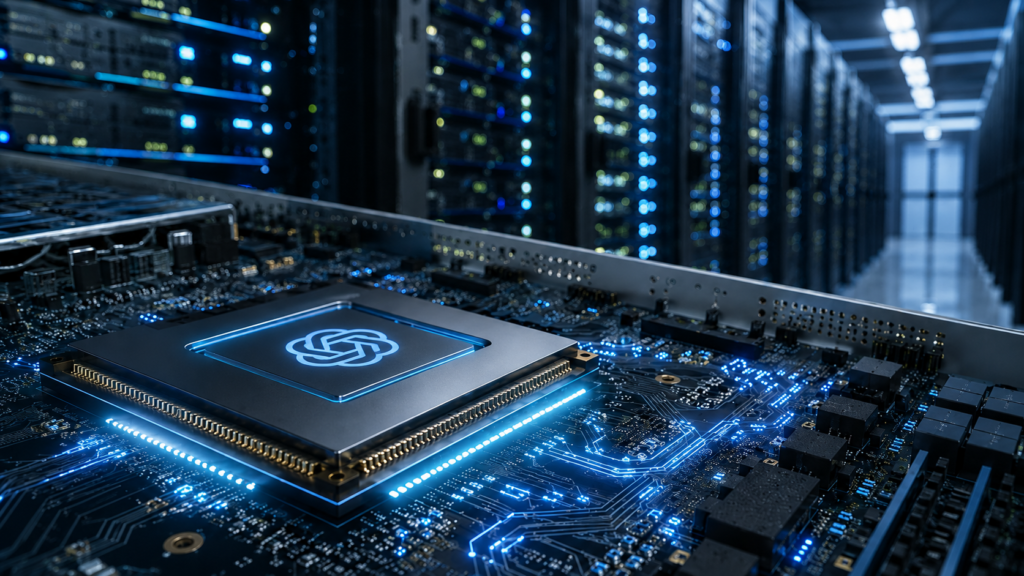
OpenAI has unveiled Jalapeño, its first custom artificial intelligence processor, developed in collaboration with Broadcom and designed specifically for large language model inference.
The announcement represents an important expansion of OpenAI’s infrastructure strategy.
Rather than relying entirely on general-purpose AI accelerators supplied by external chip companies, OpenAI is beginning to design hardware around the specific requirements of its own models, serving systems and products.
Jalapeño is intended to process inference workloads—the stage at which a trained AI model receives a request and generates an answer.
For products such as ChatGPT, Codex and AI-powered application programming interfaces, inference determines how quickly, reliably and economically a model can respond to users.
As AI adoption increases, inference is becoming one of the industry’s largest and most strategically important infrastructure requirements.
From AI models to the full technology stack
OpenAI is best known for developing frontier AI models and consumer and enterprise products.
Jalapeño moves the company deeper into the physical infrastructure layer supporting those products.
The processor was designed around OpenAI’s understanding of model architecture, software kernels, memory movement, networking requirements and real-world serving patterns.
Broadcom is supporting the implementation of the silicon and the networking technology required to connect the processors at scale, while Celestica is contributing board, rack and system-integration capabilities.
This structure reflects a broader shift in the AI industry.
Leading AI companies increasingly view chips, networking, data centres, power supply and cooling systems as strategic assets rather than interchangeable technology services.
Model development remains important, but the ability to operate those models efficiently at global scale may become an equally important source of competitive advantage.
Why inference requires specialised hardware
AI infrastructure is often discussed as though all computational workloads are similar.
In practice, training and inference have different requirements.
Training involves processing extremely large datasets to develop or improve a model. It requires substantial parallel computing power and may operate continuously for extended periods.
Inference begins after a model has been trained.
Every time a user asks a question, generates an image, runs a coding task or uses an AI agent, infrastructure must process that request and deliver a response.
At a small scale, inference may appear less demanding than training. At hundreds of millions of users and billions of interactions, however, the cumulative requirement becomes enormous.
Inference infrastructure must balance several factors:
- Processing speed
- Response latency
- Energy consumption
- Memory bandwidth
- Networking performance
- Reliability
- Cost per request
- Capacity during periods of peak demand
A processor designed specifically for these workloads may operate more efficiently than hardware designed to support a wider range of computing tasks.
OpenAI describes Jalapeño as a blank-slate design for modern large language model inference rather than a general-purpose accelerator adapted from earlier workloads.
The objective is to combine high computing throughput with lower latency and improved utilisation of memory and networking resources.
A nine-month development cycle
One of the most notable elements of the announcement is the speed of development.
OpenAI and Broadcom said Jalapeño progressed from initial design to manufacturing tape-out in approximately nine months.
Tape-out is the point at which a completed semiconductor design is transferred for manufacturing preparation.
Advanced processors commonly require long design and validation cycles because errors can be extremely expensive and difficult to correct after production begins.
OpenAI said its own AI models were used to accelerate parts of the design and optimisation process.
This creates an important industrial feedback loop.
AI models are being used to improve the hardware that will operate future generations of AI models.
If this approach proves repeatable, AI-assisted semiconductor development could reduce design times, improve optimisation and lower some of the barriers involved in creating specialised processors.
However, rapid design does not remove the challenges of manufacturing, packaging, memory supply, system integration and deployment at data-centre scale.
Engineering samples must still be tested, manufactured consistently and integrated into reliable production systems.
Early performance claims remain to be verified
OpenAI said early testing indicates that Jalapeño could deliver better performance per watt than current state-of-the-art alternatives.
Engineering samples are reportedly operating in the laboratory at their targeted frequency and power levels, including while running workloads associated with GPT-5.3-Codex-Spark.
The company has not yet released a complete independent technical benchmark.
It has said that a more detailed performance report will be provided later.
This distinction is important for investors and industry observers.
Performance per watt is one of the most significant measures in modern AI infrastructure because electricity consumption directly affects operating costs, data-centre design and the amount of computing capacity that can be installed at a particular location.
A processor that delivers more useful AI output with less electricity could improve the economics of inference.
But final results will depend on real-world deployment, software compatibility, utilisation levels, memory availability and the total cost of the surrounding systems.
Diversification rather than an immediate replacement for Nvidia
The development of Jalapeño does not necessarily mean that OpenAI will stop using processors supplied by Nvidia, AMD or other technology partners.
AI computing demand is expanding too rapidly for most major operators to depend on a single architecture or supplier.
Custom processors can provide greater control over particular workloads, but general-purpose accelerators remain valuable for model development, research and applications that require greater flexibility.
The more likely outcome is a diversified computing platform.
OpenAI may use different processor architectures for different types of workloads:
- General-purpose accelerators for research and training
- Custom processors for high-volume inference
- Specialised systems for low-latency applications
- Different hardware configurations across cloud and data-centre partners
This approach may reduce supply-chain concentration and improve OpenAI’s ability to match hardware with the economic requirements of individual products.
It may also increase competitive pressure across the semiconductor market.
Nvidia has established a powerful position through its chips, networking systems and software ecosystem. Broadcom’s role in custom processors gives large technology companies another route to infrastructure at scale.
The competition is therefore not limited to individual chips.
It increasingly involves complete systems combining processors, memory, networking, software, racks and data-centre architecture.
A multi-generation infrastructure strategy
Jalapeño is described as the first processor in a multi-generation computing platform rather than a one-time experiment.
OpenAI and Broadcom previously announced plans to collaborate on as much as 10 gigawatts of OpenAI-designed accelerator and networking systems.
Deployment was targeted to begin during the second half of 2026 and continue through the end of 2029.
Ten gigawatts represents infrastructure on an exceptionally large scale.
Delivering that capacity would require investment across several connected markets:
- Semiconductor manufacturing
- Advanced chip packaging
- High-bandwidth memory
- Optical and Ethernet networking
- Data-centre construction
- Power generation and transmission
- Cooling systems
- Backup power
- Land and industrial property
- Cloud and systems integration
The size of the planned programme illustrates why AI is becoming as much an infrastructure investment theme as a software theme.
Building frontier models requires intellectual property and technical talent.
Serving those models to a global user base also requires physical assets, energy, supply chains and long-term capital.
Implications for AI infrastructure investors
The OpenAI–Broadcom initiative may create opportunities beyond the two companies directly involved.
Custom semiconductor design
As AI laboratories and cloud providers seek greater control over cost and performance, demand may increase for companies that can design, implement and manufacture specialised processors.
High-bandwidth memory
Inference processors depend on rapid access to large amounts of data. This increases the strategic importance of advanced memory systems and the companies that supply them.
Networking infrastructure
Large AI clusters require extremely fast communication between processors. Ethernet switching, optical connectivity and data-centre networking are becoming essential components of AI performance.
Data-centre development
Gigawatt-scale deployment requires sites with access to land, grid capacity, water, cooling infrastructure and reliable power.
Energy infrastructure
The availability of electricity may become one of the largest constraints on AI expansion. Developers are increasingly evaluating long-term power agreements, generation assets, grid connections and energy-storage solutions.
Systems manufacturing
Companies that integrate chips into boards, servers and racks may benefit as custom processor programmes move from laboratory samples into commercial-scale deployment.
For private-market investors, the opportunity is therefore broader than ownership of a leading AI model company.
The supporting ecosystem includes infrastructure assets and specialised businesses throughout the semiconductor, energy and data-centre supply chains.
The strategic value of controlling infrastructure
Developing custom hardware may provide OpenAI with several potential advantages.
It can design processors around the requirements of its own models.
It can optimise software and hardware together.
It may reduce the cost of high-volume inference.
It may improve supply-chain flexibility.
It can develop infrastructure according to its long-term product roadmap rather than relying entirely on external chip development cycles.
Greater control also introduces new responsibilities.
Semiconductor programmes require large upfront investment, manufacturing commitments, technical expertise and long-term planning.
OpenAI must accurately forecast future workloads years before the infrastructure is fully deployed.
If model architectures change significantly, custom hardware may become less useful than expected.
If demand grows more slowly, costly data-centre capacity could remain underutilised.
If demand grows faster, deployment schedules and component supply may still limit capacity.
Risks investors should consider
The AI infrastructure expansion presents substantial opportunities, but it also involves material risks.
Capital intensity
Advanced chips and data centres require enormous investment before generating returns.
Technology changes
AI architectures continue to evolve. Hardware optimised for current workloads may need to adapt to future models and agent-based systems.
Manufacturing concentration
The most advanced processors depend on a limited number of semiconductor manufacturers and packaging providers.
Memory constraints
High-bandwidth memory is expensive and supplied by a relatively small group of companies.
Energy availability
Grid connections and reliable power can delay data-centre projects even when financing and technology are available.
Performance uncertainty
Early laboratory testing may not fully predict performance, reliability or cost in commercial deployment.
Return on investment
Growing AI usage does not automatically guarantee that every infrastructure investment will generate attractive financial returns.
What to watch next
Several developments will determine the long-term significance of Jalapeño.
Independent technical results
Detailed benchmarks will help clarify performance, energy efficiency and competitiveness against established accelerators.
Deployment by the end of 2026
The transition from engineering samples to operating systems inside production data centres will be an important test.
Expansion beyond inference
OpenAI may eventually explore custom processors for training or other specialised workloads.
Data-centre partnerships
The location, ownership and financing of gigawatt-scale infrastructure will influence the wider investment ecosystem.
Future processor generations
The speed at which OpenAI and Broadcom can improve the architecture will determine whether Jalapeño becomes a lasting platform.
Economics for users
The ultimate measure will be whether custom hardware produces faster, more dependable and more affordable AI services.
AI competition enters the infrastructure layer
Jalapeño demonstrates that competition in artificial intelligence is moving below the software and model layer.
The next phase will increasingly involve control over processors, memory, networking, data centres and energy.
OpenAI’s decision to develop its own inference processor does not remove its dependence on external partners. Instead, it creates a more deeply integrated ecosystem involving Broadcom, Celestica, semiconductor manufacturers, memory suppliers, cloud platforms and data-centre operators.
For investors, the announcement reinforces a central theme of the AI market:
The growth of artificial intelligence depends not only on better algorithms, but also on the ability to finance, build and operate the physical infrastructure required to deliver them at scale.
Important Information
This article is provided for general informational and educational purposes only. It does not constitute investment advice, an offer, a solicitation or a recommendation to purchase or sell any security, fund interest or investment product.
Information is based on publicly available company announcements and media reports and may change as additional technical results, deployment details and regulatory information become available.