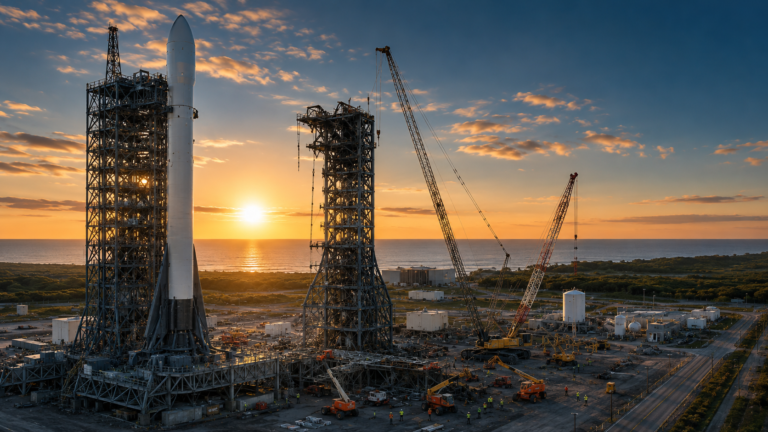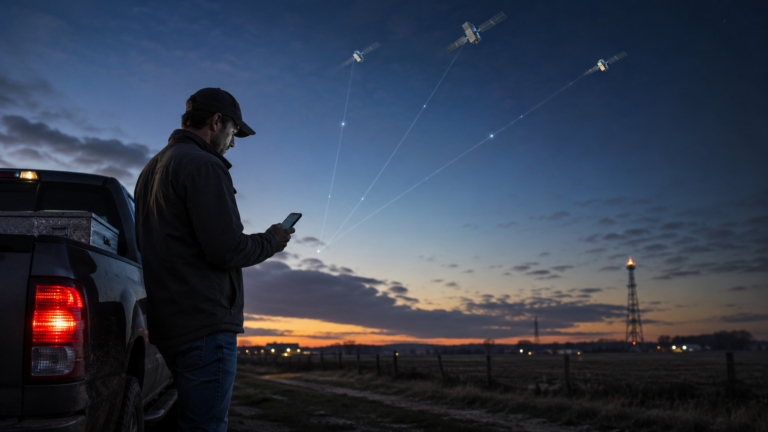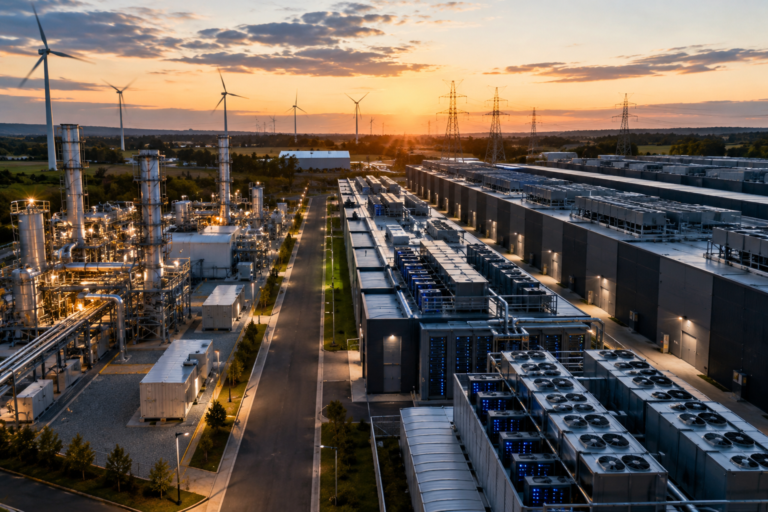
NVIDIA’s new full-stack safety architecture, together with Agility Robotics’ commercial deployments and planned public listing, signals that humanoid robotics is moving from controlled demonstrations toward industrial-scale adoption.
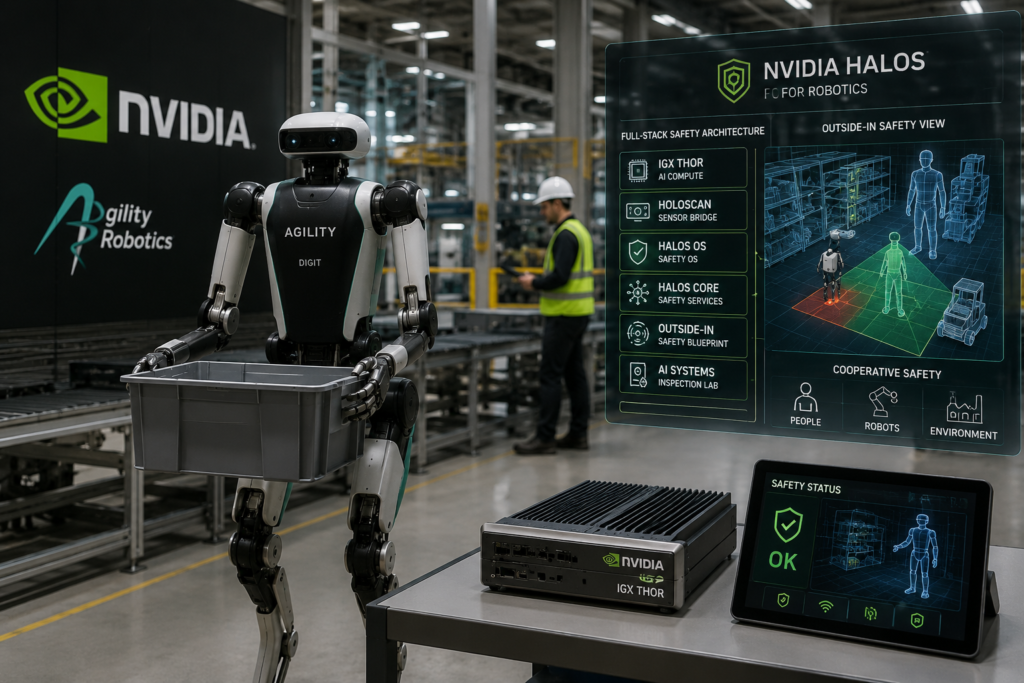
NVIDIA has introduced Halos for Robotics, a full-stack safety architecture designed for humanoid robots, industrial machines and other physical AI systems operating alongside people.
The announcement represents an important step in the development of commercial robotics.
For much of the past decade, attention has focused on whether humanoid robots can walk, lift objects, recognise their surroundings and learn new tasks.
As the technology moves into factories, warehouses and logistics facilities, a different question is becoming more important:
Can these machines perform useful work safely and consistently around employees, equipment and other autonomous systems?
NVIDIA is attempting to address that challenge by combining computing hardware, operating software, sensor connectivity, safety applications and inspection tools within a common architecture.
Agility Robotics, developer of the Digit humanoid robot, is the first announced company working to incorporate elements of Halos into its own safety platform.
The partnership arrives at a significant moment for the robotics industry.
Only two days after NVIDIA announced Halos, Agility Robotics disclosed an agreement to become a publicly listed company through a merger with Churchill Capital Corp XI.
Together, the announcements illustrate how technical infrastructure, industrial deployment and capital formation are beginning to converge around physical AI.
What is NVIDIA Halos for Robotics?
NVIDIA describes Halos for Robotics as a comprehensive safety system connecting the major layers required to develop, validate and deploy autonomous machines.
The platform includes several principal components.
NVIDIA IGX Thor
IGX Thor provides industrial-grade AI computing designed for real-time robotics and safety-related workloads.
Humanoid robots must process information from cameras, force sensors, depth sensors and other devices while simultaneously planning movements and responding to changes in their surroundings.
Unlike an AI chatbot, a robot cannot wait several seconds before reacting to a person entering its path.
Its computing system must recognise the situation and make a safe decision almost immediately.
Holoscan Sensor Bridge
The sensor bridge connects the robot’s computing platform with the cameras and other devices used to observe its environment.
Reliable sensor connectivity is essential because a robot’s safety decisions are only as dependable as the information it receives.
Missing, delayed or corrupted sensor data could cause the machine to misunderstand what is happening around it.
Halos OS and Halos Core
Halos OS provides the software foundation for safety-related operating functions and applications.
Halos Core is intended to support the underlying processes required to supervise robot behaviour and manage safety functions across the system.
This allows developers to build safety into the operating architecture rather than treating it as a separate feature added after the robot has already been designed.
Outside-In Safety Blueprint
NVIDIA’s Outside-In Safety Blueprint expands perception beyond the sensors installed directly on a robot.
External cameras and AI agents positioned inside a warehouse or factory can observe the wider environment, identify blind spots and create dynamic safety zones.
For example, an overhead camera may detect a worker approaching from behind shelving where the robot’s own sensors have limited visibility.
The external system can then instruct the robot to slow down, stop or change its path.
Halos AI Systems Inspection Lab
NVIDIA has also established an inspection framework intended to help companies prepare robotic systems for third-party certification.
The programme evaluates functional safety, AI behaviour and cybersecurity across the system.
NVIDIA says more than 40 manufacturers, safety vendors, software companies and certification organisations are participating in the wider Halos ecosystem. [1]
Why robot safety requires a full-stack approach
Industrial robots are not new.
Traditional manufacturing robots have been used for decades in automotive plants and other controlled environments.
Many of these machines operate behind protective fences or inside restricted areas because they move with sufficient speed and force to injure a person.
Humanoid robots are intended to operate differently.
Their value proposition is partly based on the ability to work in facilities originally designed for people.
They may need to move between workstations, handle existing containers, navigate narrow aisles and interact with human employees.
This creates a more complicated safety challenge.
The robot must understand:
- Where people and equipment are located
- Which objects may be touched or moved
- How much force can safely be applied
- Whether a planned movement could create a collision
- When an unexpected event requires the robot to stop
- Whether software or sensor information has been compromised
- How to remain safe when part of the system fails
These decisions involve more than mechanical engineering.
They depend on processors, software, AI models, networking, sensors, cybersecurity and the surrounding industrial environment.
A weakness in any layer may affect the behaviour of the complete system.
This is why NVIDIA is positioning Halos as an architecture spanning the entire robotics stack rather than as a single emergency-stop feature.
Agility Robotics becomes the launch partner
Agility Robotics is integrating NVIDIA IGX Thor and Halos Core into the proprietary human-detection and safety systems supporting its Digit humanoid robot.
Digit is designed for tasks in manufacturing, distribution and logistics facilities.
The robot’s two-legged form allows it to work in environments that include stairs, narrow passages, existing shelving and equipment designed around human dimensions.
Agility says Digit is already operating in commercial environments involving companies such as Schaeffler, GXO, Toyota Motor Manufacturing Canada and Mercado Libre.
NVIDIA also identified Amazon among the organisations associated with Agility’s deployments and development activities. [1][2]
The collaboration will include participation in NVIDIA’s inspection programme, with safety-related software, AI components and cybersecurity protections evaluated against recognised standards before final certification by external organisations.
The objective is what Agility calls “cooperative safety.”
Under current industrial practices, robots and employees may still need to operate in substantially separated areas.
Cooperative safety would allow robots and people to work more closely inside dynamic environments without relying entirely on physical barriers.
Achieving that capability could expand the number of tasks that humanoid robots are able to perform.
It could also reduce the cost of redesigning factories and warehouses around automation.
From controlled deployments to commercial scale
Agility’s recent public-market announcement provides additional evidence that humanoid robotics is entering a capital-intensive commercial phase.
The company has agreed to merge with Churchill Capital Corp XI in a transaction assigning Agility a pre-money equity value of approximately $2.5 billion.
The proposed combination is expected to provide more than $620 million in gross proceeds, including cash held by the special-purpose acquisition company and approximately $200 million from a private investment in public equity financing.
After closing, the combined company is expected to operate as Agility and seek a listing under the ticker symbol AGLT. [2]
According to Agility’s announcement, Digit robots have accumulated more than 65,000 operating hours across customer deployments.
The company also reports more than $300 million of multi-year contracted orders for its next-generation Digit v5, subject to contractual milestones.
Agility says its customer pipeline includes more than 30 organisations and that deployments have been committed across nine facilities. [2]
These figures are company disclosures rather than independently verified measures of future revenue.
Nevertheless, they indicate that the commercial discussion is shifting beyond laboratory prototypes.
Customers are beginning to evaluate fleet deployments, operating performance, productivity and the financial return generated by robots in live industrial environments.
Why safety matters to the investment case
Humanoid robots may offer a compelling technology story, but investors ultimately need to understand whether they can become commercially dependable assets.
Safety directly affects several parts of that analysis.
Customer adoption
Large manufacturers and logistics companies are unlikely to deploy robots widely unless they can operate reliably around employees.
A serious safety incident could delay adoption across the entire industry.
Insurance and liability
The cost of insuring robot deployments may depend on whether companies can demonstrate validated safety systems, documented controls and compliance with recognised standards.
Regulatory approval
Governments may introduce more detailed requirements as humanoid robots move into workplaces and public environments.
Companies with mature safety architectures may be better prepared for regulation.
Deployment speed
Building safety into a common platform may shorten the time required to validate new applications and customer sites.
Operating continuity
A safe system must do more than prevent injuries.
It should also reduce unexpected shutdowns, equipment damage and interruptions to production.
Customer return on investment
A robot that requires constant supervision or must remain isolated from employees may deliver less economic value than one capable of operating safely within normal workflows.
Safety is therefore not only a compliance issue.
It may become an important determinant of commercial performance.
NVIDIA’s platform strategy expands beyond chips
NVIDIA does not appear to be attempting to manufacture its own humanoid robot.
Instead, it is supplying the infrastructure used by multiple robotics companies.
This approach resembles the company’s broader strategy in AI data centres.
NVIDIA provides processors, networking, software libraries, simulation environments and development tools while other companies build the final products and services.
In robotics, the platform may include:
- AI processors
- Real-time operating systems
- Sensor connectivity
- Foundation models
- Simulation technology
- Cybersecurity
- Safety applications
- Certification support
- Developer tools
NVIDIA has also announced a reference humanoid design combining its computing systems with robot hardware supplied by Unitree and dexterous hands supplied by Sharpa.
The company has said it plans to work with additional humanoid manufacturers in the United States, Europe and South Korea. [3]
This strategy allows NVIDIA to participate in the growth of the wider robotics industry without depending on a single robot manufacturer.
If multiple companies adopt a common computing and software architecture, NVIDIA may benefit as the number of deployed robots increases.
Physical AI extends the semiconductor opportunity
Humanoid robots require a different form of computing from conventional industrial machines.
They must process large amounts of sensor data, interpret complex environments and generate physical actions in real time.
This could create demand across several semiconductor categories.
AI processors
Robots need accelerated computing to run perception, reasoning and control models.
Safety microcontrollers
Dedicated processors may supervise critical functions and provide redundancy if the primary AI system fails.
Sensors
Cameras, radar, lidar, force sensors and inertial systems help robots understand their surroundings and physical condition.
Motor-control chips
Robotic joints require precise control over actuators and electrical motors.
Networking components
Factories may use local edge systems and external cameras to coordinate fleets of robots.
Power-management systems
Battery-powered humanoids require efficient control over energy use, charging and thermal performance.
NVIDIA’s Halos ecosystem includes companies such as Infineon, NXP Semiconductors, STMicroelectronics and Texas Instruments, demonstrating that commercial robotics may become a broader semiconductor opportunity rather than a market limited to high-end AI chips. [1]
Simulation may reduce the cost of robot development
Training a robot entirely through real-world experience is expensive and potentially dangerous.
Developers must collect large amounts of data while protecting workers, facilities and the robot itself.
Simulation allows companies to create virtual factories and test many scenarios before physical deployment.
Robots can practise tasks, experience rare events and encounter different layouts without creating real-world risk.
Simulation can also support safety validation.
Developers may test how the robot responds when:
- A person enters its path unexpectedly
- A sensor becomes unavailable
- An object falls nearby
- The floor surface changes
- Network communication is interrupted
- Another robot blocks the intended route
Virtual testing cannot replace real-world validation, but it may reduce development time and allow companies to explore situations that would be difficult or unsafe to reproduce physically.
This creates opportunities for simulation software, synthetic data, digital twins and industrial edge-computing platforms.
The private-market opportunity
Humanoid robotics remains an emerging market, but the supporting investment ecosystem is becoming broader.
Robotics manufacturers
Companies such as Agility, Figure AI and other developers require capital for engineering, production, inventory and customer deployment.
Component suppliers
Motors, actuators, sensors, batteries, processors and robotic hands may become specialised high-growth markets.
Manufacturing infrastructure
Large-scale production will require factories, tooling, testing equipment and supply-chain capacity.
Agility’s RoboFab facility is designed to support annual production of as many as 10,000 humanoid units, according to the company. [2]
Robotics software
Fleet management, task planning, cybersecurity and system monitoring may generate recurring software revenue.
Deployment financing
Customers may prefer leasing, robotics-as-a-service or usage-based contracts instead of purchasing robots outright.
This could create opportunities for asset-backed lending, equipment finance and specialised private credit.
Industrial integration
Factories and warehouses may need redesigned workflows, external sensors, charging infrastructure and local computing systems.
Safety and certification
Testing laboratories, engineering firms, insurers and compliance specialists may benefit as deployment standards become more formalised.
The investment opportunity therefore extends beyond selecting which humanoid manufacturer will produce the most successful robot.
It includes the complete infrastructure required to manufacture, finance, deploy and supervise autonomous machines.
Key risks for investors
The commercial potential is significant, but humanoid robotics still faces considerable uncertainty.
Technology reliability
Robots must operate for long periods without frequent failure or human intervention.
Safety incidents
A serious accident could lead to litigation, regulatory restrictions and reduced customer confidence.
High manufacturing costs
Complex actuators, processors, sensors and batteries may keep unit costs elevated.
Uncertain productivity
A robot demonstration does not prove that the system can deliver an attractive return across thousands of operating hours.
Customer concentration
Early robotics companies may depend on a small number of large industrial customers.
Capital intensity
Manufacturing facilities, inventories and field-support networks require substantial funding.
Rapid competition
Large technology companies, automotive groups and well-funded startups are all developing physical AI systems.
Supply-chain exposure
Robotics companies may depend on specialised components produced by a limited number of suppliers or countries.
Regulation
Workplace safety, data protection and product-liability rules may evolve as the technology enters wider use.
What to watch next
Several developments will determine whether humanoid robotics moves from early deployment to a scalable industrial market.
Certification progress
The industry will need recognised methods for evaluating AI behaviour, functional safety and cybersecurity.
Digit v5 deployment
Agility’s next-generation robot will test whether cooperative safety can operate consistently in real industrial workflows.
Completion of the Agility transaction
The proposed public listing could provide capital for production and deployment, but remains subject to shareholder, regulatory and closing conditions.
Customer economics
Investors will look for evidence showing labour savings, productivity improvements, utilisation and payback periods.
Manufacturing scale
Robotics companies must demonstrate that they can produce reliable machines consistently and at lower cost.
New financing models
Leasing and robotics-as-a-service structures may play an important role in accelerating adoption.
NVIDIA’s wider partnerships
Additional robot manufacturers adopting NVIDIA’s safety and computing infrastructure would strengthen its position as a common physical AI platform.
Safety may determine who reaches commercial scale
Humanoid robotics has attracted attention through impressive demonstrations.
The next stage will be measured differently.
Industrial customers will evaluate whether robots can work safely, complete useful tasks, operate reliably and generate measurable economic value.
NVIDIA’s launch of Halos reflects this transition.
The industry is beginning to build not only more capable robots, but also the safety, inspection and certification infrastructure required to place those robots inside real businesses.
Agility Robotics’ planned public listing adds a capital-markets dimension to the same trend.
Large-scale humanoid deployment will require continued investment in engineering, manufacturing, software, field operations and customer financing.
For private-market investors, physical AI may develop into a significant technology and industrial-infrastructure theme.
But the companies most likely to succeed may not be those producing the most dramatic demonstrations.
They may be the companies capable of combining intelligence, safety, manufacturing discipline and dependable commercial performance.
Important Information
This article is provided for general informational and educational purposes only. It does not constitute investment advice, an offer, a solicitation or a recommendation to purchase or sell any security, fund interest or investment product.
The proposed Agility Robotics transaction remains subject to applicable approvals and closing conditions. Company orders, pipeline figures, market estimates and production targets are forward-looking disclosures and may not result in recognised revenue or completed deployments.