
The company is targeting a return to flight before the end of 2026 after a ground-test accident damaged its only New Glenn launch complex, highlighting the operational and financial importance of specialised space infrastructure.
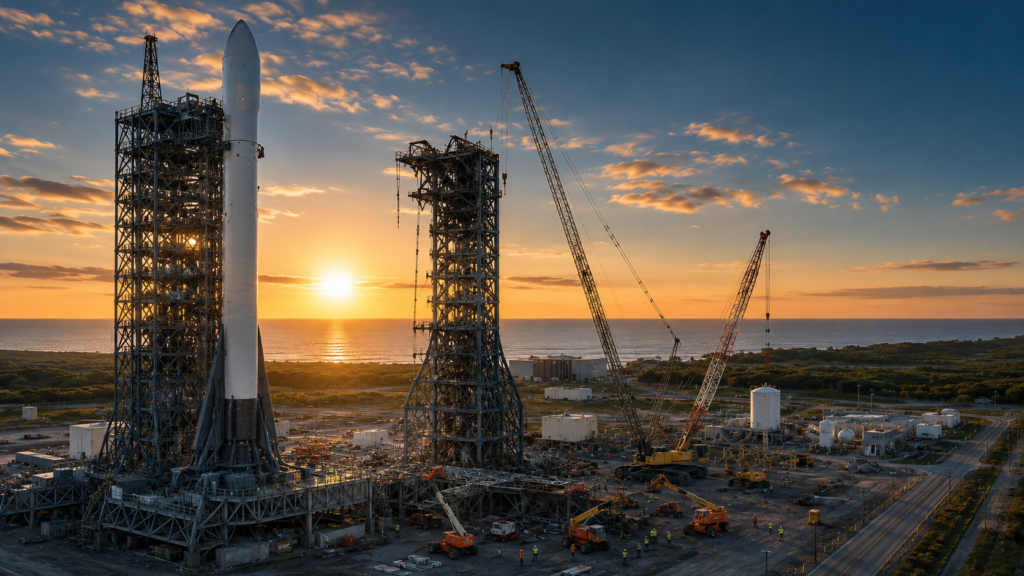
Blue Origin has begun rebuilding Launch Complex 36 in Florida after an uncrewed New Glenn rocket exploded during a ground engine test on May 28.
Chief Executive Dave Limp said reconstruction had started and that the company still expected New Glenn to return to flight before the end of 2026. No injuries were reported in the accident. [1]
The incident represents more than a temporary delay to a single rocket.
New Glenn currently depends on one operational launch complex at Cape Canaveral Space Force Station. Damage to that site affects Blue Origin’s ability to launch commercial satellites, support customers developing space-based communications networks and advance its lunar programmes for NASA.
The recovery therefore illustrates a wider investment reality:
In capital-intensive technology industries, the most advanced vehicle or software platform can still be constrained by a single piece of physical infrastructure.
What happened at Launch Complex 36?
The accident occurred during a hot-fire test, a standard procedure in which a rocket’s engines are ignited while the vehicle remains secured to the ground.
Hot-fire tests allow engineering teams to evaluate engines, fuel systems, software, ground equipment and launch procedures before flight.
Blue Origin initially described the event as an anomaly and confirmed that all personnel had been accounted for. The company later regained partial access to the site and began investigating the cause. [2]
The rocket was being prepared for New Glenn’s fourth mission.
The planned launch was expected to carry 48 satellites for Amazon’s Leo broadband constellation, which is being developed as a competitor to SpaceX’s Starlink network. [3]
The satellites were not installed on the rocket at the time of the accident.
Blue Origin has not publicly announced a final cause, and the recovery timetable remains dependent on the investigation, replacement equipment, testing and regulatory review.
Key infrastructure survived
Although the accident caused substantial visible damage, several of the most difficult-to-replace assets reportedly survived.
Blue Origin said important parts of the launch complex remained intact, including elements of the propellant tank farm and systems associated with liquid hydrogen, liquefied natural gas and liquid oxygen.
Nearby boosters and upper stages stored inside the integration facility also appeared to remain in usable condition following initial inspections. [1][3]
The main support tower and surrounding launch-pad equipment require repair or replacement.
This distinction is important.
A modern orbital launch site is not simply a concrete platform.
It contains a highly specialised network of systems, including:
- Cryogenic fuel storage
- High-pressure pipes and valves
- Electrical distribution
- Communication systems
- Fire suppression
- Lightning protection
- Rocket transport equipment
- Launch control systems
- Environmental monitoring
- Exhaust and flame-management structures
- Vehicle access and servicing platforms
Some components can be manufactured or installed relatively quickly.
Others have long lead times, specialised certification requirements or limited supplier availability.
Preserving the tank farm and nearby flight hardware may significantly reduce the time required to restore operations.
Launch pads are a scarce form of infrastructure
Commercial space companies are often valued according to rocket technology, satellite contracts and future market demand.
The launch site itself can receive less attention.
In practice, launch infrastructure is one of the most difficult parts of the industry to reproduce.
A suitable site must offer access to safe flight corridors, transportation infrastructure, government approvals and sufficient distance from populated areas.
Developers must then construct facilities capable of handling volatile fuels, extreme heat, vibration and large quantities of exhaust.
Launch sites are also regulated environments involving federal agencies, military installations, local authorities and environmental requirements.
This creates a limited supply of locations suitable for frequent orbital missions.
Blue Origin’s dependence on one New Glenn pad demonstrates the risk created by infrastructure concentration.
Even when rockets, satellites and customers remain available, launch activity may stop if the pad cannot operate.
The cost of a delayed launch calendar
A prolonged grounding can affect several parts of a space company’s business.
Deferred revenue
Launch providers are generally paid according to contractual milestones and successful mission performance.
When flights are postponed, expected revenue may move into a later reporting period.
Customer disruption
Satellite operators design deployment schedules around contracted launch dates.
A delay may affect testing, regulatory deadlines, commercial service launches and relationships with telecom partners.
Higher operating costs
Engineering staff, launch teams and manufacturing facilities continue to generate expenses while the rocket remains grounded.
Rework and additional testing
Replacement hardware and repaired systems must be inspected and validated before operations resume.
Insurance and contractual exposure
Mission delays may affect insurance arrangements and contractual responsibilities, depending on the terms agreed with customers.
Competitive pressure
Customers may shift future missions to other launch providers if they believe capacity or scheduling reliability is uncertain.
The financial consequences therefore extend beyond the physical cost of rebuilding the pad.
Competition in the heavy-lift launch market
New Glenn is central to Blue Origin’s attempt to compete in the higher-capacity commercial launch market.
The rocket uses a reusable first stage and a large seven-metre payload fairing designed to accommodate heavy satellites and multiple spacecraft.
Blue Origin successfully landed a reused New Glenn booster during the rocket’s third mission in April 2026.
However, the upper stage placed AST SpaceMobile’s BlueBird 7 satellite into an orbit that was lower than planned. The satellite powered on after separation but could not maintain operations at the resulting altitude and was expected to re-enter the atmosphere. [4]
That mission demonstrated progress in booster recovery while also highlighting the operational challenge of achieving consistent performance across the complete launch system.
The May accident created an additional setback shortly afterward.
Blue Origin is competing against SpaceX, whose Falcon 9 has established a high launch frequency and a mature reusable-booster system.
It also competes with United Launch Alliance, Arianespace and other providers for government, commercial and constellation missions.
For customers, price matters.
Schedule certainty, launch frequency and mission reliability can be equally important.
Amazon Leo increases the pressure to recover quickly
Amazon is developing a large low-Earth-orbit satellite network intended to provide broadband connectivity.
Deploying a constellation requires many launches over a limited period because satellites must be placed into multiple orbital planes before the network can offer broad coverage.
Amazon has diversified its launch arrangements across Blue Origin, United Launch Alliance and Arianespace.
This reduces dependence on a single rocket, but major delays at one provider may still complicate the overall deployment schedule.
New Glenn’s planned mission involving 48 Amazon Leo satellites would have represented a significant operational step for both companies.
For Blue Origin, it would demonstrate the ability to deploy a large commercial satellite batch.
For Amazon, it would add capacity to a network competing in a market where Starlink already has substantial operating scale.
The launch-pad recovery is therefore connected not only to Blue Origin’s rocket business, but also to competition within global satellite communications.
Lunar missions add another strategic dependency
New Glenn also supports Blue Origin’s plans beyond commercial satellite launches.
The company is developing Blue Moon lunar landers for NASA’s Artemis programme.
NASA’s updated Artemis III architecture calls for test versions of commercial landers from Blue Origin and SpaceX to rendezvous and dock with the Orion spacecraft in low-Earth orbit during a crewed mission planned for 2027.
NASA says Blue Origin’s lander pathfinder is expected to launch first and remain in orbit while awaiting Orion. A SpaceX Starship test article would participate later in the same mission sequence. [5]
Blue Origin has said its uncrewed Mark 1 lunar lander mission is now expected to fly in early 2027. [1]
These plans make the New Glenn recovery relevant to NASA’s broader exploration schedule.
A launch-pad delay can influence not only commercial customers but also hardware testing, lander development and government mission coordination.
Why rebuilding speed matters
Blue Origin has brought in teams working continuously to clear debris and reconstruct the site.
A fast recovery could help protect customer confidence and preserve the company’s planned mission sequence.
Speed alone is not sufficient.
The company must also demonstrate that it understands the cause of the accident and has corrected any weaknesses affecting the vehicle or launch infrastructure.
The recovery process may include:
- Securing and clearing the site
- Documenting the damage
- Investigating the technical cause
- Replacing structural and mechanical equipment
- Inspecting surviving systems
- Rebuilding software and control interfaces
- Conducting pressure and fuel-system tests
- Performing integrated system checks
- Completing another hot-fire test
- Receiving required regulatory approval
Each step creates dependencies.
A missing valve, damaged cable system or delayed structural component can affect the complete schedule.
Lessons from SpaceX’s 2016 pad accident
Launch providers have recovered from similar accidents before.
In 2016, a SpaceX Falcon 9 exploded on a launch pad during preparations for a hot-fire test.
SpaceX returned the Falcon 9 to flight approximately four months later, although recovery involved technical investigation, infrastructure repairs and changes to operating procedures. [3]
The comparison demonstrates that launch-pad accidents do not necessarily create permanent damage to a programme.
It also shows that recovery depends on engineering capability, available infrastructure, supply-chain access and regulatory coordination.
Blue Origin’s challenge is different because New Glenn is still building its flight history and currently operates from a single launch pad.
SpaceX had a more established operational programme and access to other launch infrastructure.
Infrastructure redundancy can therefore be as important as vehicle redundancy.
The private-market investment perspective
The reconstruction of Launch Complex 36 highlights several themes relevant to infrastructure and private-capital investors.
Highly specialised assets can create barriers to entry
Launch complexes require large amounts of capital, technical expertise and regulatory coordination.
These requirements can protect established operators from new competition.
Concentration creates operational risk
A single launch pad can become a bottleneck for an otherwise diversified programme.
Investors should examine whether critical assets have backups or alternative operating sites.
Long-lead equipment affects recovery value
The financial effect of an accident depends partly on which components are damaged.
Assets with long manufacturing or certification periods can determine the true recovery timetable.
Customer contracts depend on physical capacity
A large order book does not guarantee revenue if a company lacks the infrastructure needed to deliver its services.
Government and commercial demand can overlap
The same rocket and launch site may serve satellite companies, national-security customers and civil space agencies.
This can broaden revenue opportunities while increasing scheduling complexity.
Insurance does not remove business interruption risk
Property or launch insurance may cover certain losses, but it cannot immediately restore customer confidence or replace lost time.
Opportunities around launch infrastructure
Commercial-space growth may create investment opportunities beyond rocket manufacturers.
Potential areas include:
- Launch-site construction
- Cryogenic storage systems
- Specialised engineering services
- Propellant infrastructure
- Satellite-processing facilities
- Tracking and communication systems
- Industrial land near spaceports
- Power and utility infrastructure
- Transportation and logistics
- Testing and certification
- Cybersecurity for launch systems
- Environmental monitoring
As launch frequency increases, these supporting assets may become a larger part of the industry’s total capital requirements.
Private infrastructure funds, specialist lenders and industrial investors may participate through project financing, equipment finance, real estate partnerships and supply-chain investment.
Key risks to monitor
Investigation risk
The cause of the hot-fire accident has not yet been publicly determined.
A complex root cause could extend the recovery timetable.
Schedule risk
A year-end return remains a target rather than a guaranteed date.
Regulatory risk
Authorities may require additional testing or operational changes.
Customer concentration
Major constellation customers can provide substantial revenue but may also have significant negotiating power.
Competitive risk
Customers have alternatives, particularly for missions compatible with other launch vehicles.
Technology risk
Reusable heavy-lift systems remain technically demanding and require consistent performance across many subsystems.
Infrastructure concentration
New Glenn’s current reliance on Launch Complex 36 remains an important vulnerability.
What to watch next
Several developments will determine whether Blue Origin can meet its recovery target.
Publication of the investigation findings
A confirmed cause and corrective-action plan would provide greater clarity.
Completion of major structural repairs
Progress on the support tower and launch equipment will indicate whether long-lead components remain a constraint.
A successful integrated hot-fire test
The next full engine test will be a critical milestone before flight.
Rescheduling of Amazon Leo missions
A revised launch date would show how quickly commercial operations may resume.
Timing of the Mark 1 lunar lander
Further delays could affect Blue Origin’s lunar-development sequence.
Development of additional launch capacity
Longer term, Blue Origin may need greater infrastructure redundancy to support a higher launch frequency.
Physical infrastructure remains central to the space economy
The commercial-space industry is often presented as a story of reusable rockets, satellite networks and ambitious lunar missions.
Those technologies still depend on industrial assets located on the ground.
Launch pads, propellant systems, factories, test stands and integration facilities determine whether missions can take place on schedule.
Blue Origin’s reconstruction effort is therefore more than a repair project.
It is a test of whether the company can restore a critical asset, protect its commercial relationships and maintain momentum across satellite and lunar programmes.
For investors, the lesson is broader.
In complex technology markets, competitive advantage does not come only from intellectual property.
It also depends on the resilience, redundancy and operating reliability of the physical infrastructure that turns technology into a commercial service.
Important Information
This article is provided for general informational and educational purposes only. It does not constitute investment advice, an offer, a solicitation or a recommendation to purchase or sell any security, fund interest or investment product.
Commercial-space and infrastructure investments may involve technical failure, construction delays, regulatory uncertainty, customer concentration, illiquidity and possible loss of capital.